
Presentation and diagnosis
Squamous cell carcinoma (SCC) in situ (also known as intraepidermal carcinoma or Bowen disease) presents as a slowly expanding, well-demarcated, erythematous scaly plaque—it can be mistaken for psoriasis or dermatitis. SCC in situ is usually asymptomatic, but can ulcerate or bleed. It can occur anywhere, but most commonly in sun-exposed areas, especially the lower legs. See here for photos of SCC in situ.
Genital lesions (females: vulval intraepithelial neoplasia; males: penile intraepithelial neoplasia [also known as Bowen disease of the penis or erythroplasia of Queyrat]) and subungual lesions correlate strongly with human papillomavirus infection. On average, any untreated SCC in situ lesion has a 3 to 8% risk of invasion, but untreated genital lesions have a higher risk.
Confirm with a biopsy if the diagnosis is not certain. For large lesions (especially hypertrophic or verrucous lesions), consider the risk of sampling error that misses foci of invasive SCC.
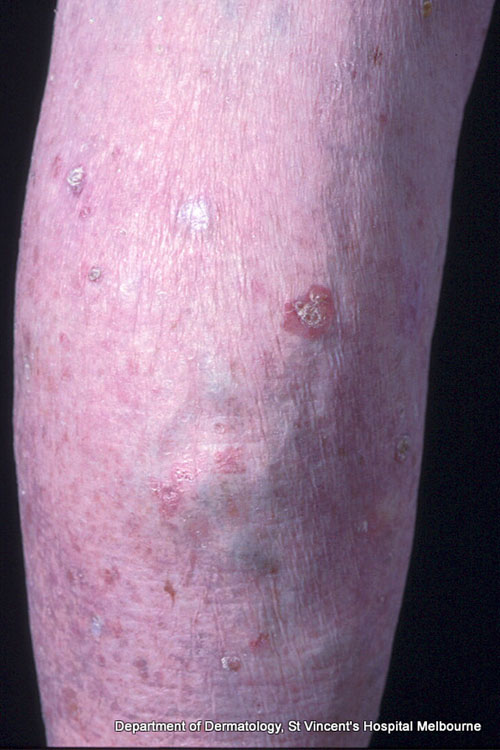
Reproduced with permission from the A-Z of Skin [digital]. Australasian College of Dermatologists. Sydney. https://www.dermcoll.edu.au/
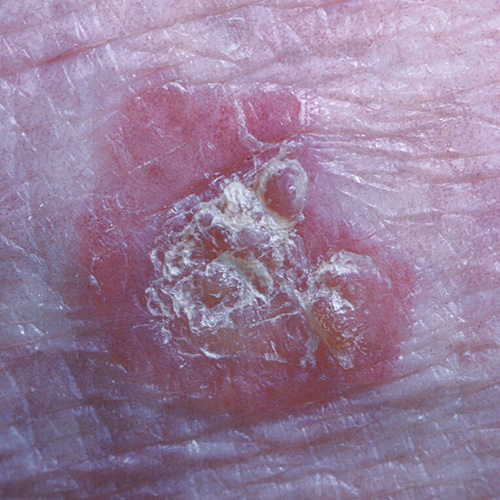
Reproduced with permission from the A-Z of Skin [digital]. Australasian College of Dermatologists. Sydney. https://www.dermcoll.edu.au/